
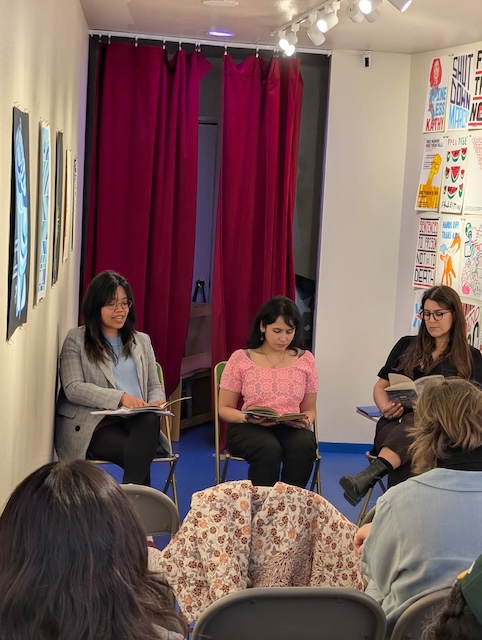
IF YOU ARE INTERESTED in independent and risography publishing, there’s a bookstore in San Diego called Burn All Books. I loved the name before I loved anything else about it, it might be my affinity for destruction, and that small act of arson, a refusal to hegemonic things. On May 17th, I sat in front of a room and presented La Antología de Isotopías, Vol. 1 for the first time on the San Diegan side of the border, and for the first time entirely in English.
I want to sit with that for a second, because it isn’t a small thing. Isotopías was born in Spanish, in Itzel’s apartment on Avenida Revolución in Xalapa, out of anger, out of laughing at the fact that our university has a magazine called La palabra y el hombre (The Word and the Man), and out of being tired of the same men getting published issue after issue. We wanted the voices that weren’t talking the most in class. We noticed it was the same in the Mexican professional realm, white men being published over and over. We decided to create our own magazine, and we started online because online reaches further: someone in Cuba can read a writer from Tijuana the same day we publish her. It was also born out of our desire to read stories written by migrants. Three years and over two hundred pieces later, we made a book, because I met the right people at the right time: Traducciones Trepidantes showed me the world of the printing process. Before, I had just edited on indesign but never really dealt with the printing part. Itzel and I also mentioned that printing would be a good idea because digital disappears, and a book on a shelf doesn’t. It gets lent, hopefully passed around, and even found in a used bookstore ten years from now. Maybe even in this one.
But we made all of that in Spanish, in my mother tongue and the one I studied literature in. To stand in San Diego and tell that story in English was to walk Isotopías across the same line some of our writers cross every day. The voice doesn’t change when it crosses, that’s an important point of the anthology, but the room does. I held up Volume One the way I always do, said this is it, and for once the this was landing in English, in the United States, in a room with the friends who I had worked with in Trembling Translations, and who had come to listen and support.
I wasn’t alone up there. Two of my closest friends in San Diego presented with me: Nilufar Karimi and Vyxz Vasquez, both of them in the anthology, both of them reading from it and from new work. They are the reason the night sounded like Isotopías and not like me reciting a press release or a soliloquy. When you’ve spent three years making something online, there’s a particular kind of vertigo in finally hearing it out loud, in other people’s voices, in a real room. Vyxz and Nilufar gave me that. Before heading to BAB, we stopped by for a quick drink, where we shared laughs and tamed our nerves.
After presenting the book and reading an excerpt of “The Last Night”, Vyxz read “A Slowness / Una lentitud,” her poem from the anthology, the one dedicated to me, the one I translated into Spanish myself, which means I’ve lived inside its lines word by word and still heard something new when she said them out loud. It’s a poem about the American spectacle, about how even our language gets colonized by the verbiage of the game, and about slowness as the one thing the spectacle can’t sell you. Then she read new work, mostly sonnets, holding that old form open to whatever she wanted to put in it.
Vyxz is from the Philippines, in San Diego for grad school and speaks tagalog; Nilufar’s poem moves right to left and translates from farsi to english; I came from my Spanish mother tongue to present in English. None of us are 100 % from here, and that’s exactly the room Isotopías is for.
Nilufar read “To be read from right to left,” a poem whose title alone does the work the whole anthology is trying to do: it asks you to move against the direction you were trained to move in, to read the other way, to let the periphery dictate the terms. In a room where she had just presented left to right, in English, at the border, that felt like the truest thing anyone could have said. Then she read a political poem, and the air in the room changed. That poem is the anthology, exactly: anger at the injustices, real anger, named and unhedged, and somehow, underneath it, hope. The kind that survives because it refuses not to. That’s the tone I’d been trying to describe all night and couldn’t, and Nilufar just read it into the room in a few minutes. That’s what poems are for.
We told everyone what’s new. We now have the ISSN, so Isotopías is officially on the record now as a serial publication; three posts a week online; and what’s to come: Volume Two already turning over in our heads; our first in-person workshop soon. And I asked, the way I always ask: if you write about migration, about the peripheries, about the people and places that don’t usually get centered, send us your work. If you make music or video or visual art that lives in those questions, send that. If you translate between any languages and you want to carry a writer across that line, we want you. Everything’s at isotopias.org.
I started this project because we wanted to hear the people who weren’t talking the most in the room. At Burn All Books, in English, for the first time, I got to hear them talk: Nilufar, Vyxz, the whole anthology, and the room was listening, nobody asked questions, I would like to think it was because we said it all and we were clear. That’s the night. That’s what it was for.
*
Burn All Books: la primera noche en inglés
Si te interesan los libros independientes y la risografía, hay una librería en San Diego que se llama Burn All Books. Me enamoré del nombre antes que de cualquier otra cosa de ella; será mi afinidad por la destrucción, por ese pequeño acto de incendio, esa negación a las cosas. El 17 de mayo me senté frente a una sala y presenté La Antología de Isotopías, Vol. 1 por primera vez del lado sandieguino de la frontera, y por primera vez completamente en inglés.
Quiero detenerme un segundo en eso, porque no es cosa menor. Isotopías nació en español, en el departamento de Itzel sobre Avenida Revolución en Xalapa, desde el enojo, desde la risa ante el hecho de que nuestra universidad tuviera una revista llamada La palabra y el hombre, y desde el cansancio de ver a los mismos hombres publicados número tras número. Queríamos las voces que no eran las que más hablaban en clase. Notamos que pasaba lo mismo en el ámbito profesional mexicano: hombres blancos publicados una y otra vez. Decidimos crear nuestra propia revista, y empezamos en línea porque lo digital llega más lejos: alguien en Cuba puede leer a una escritora de Tijuana el mismo día en que la publicamos. Tres años y más de doscientas piezas después, hicimos un libro, porque conocí a las personas indicadas en el momento indicado: Traducciones Trepidantes me mostró el mundo del proceso de impresión. Antes solo había editado en InDesign, pero nunca me había metido de lleno en la parte de la imprenta. Itzel y yo también dijimos que imprimir sería buena idea porque lo digital desaparece, y un libro en una repisa no. Se presta, ojalá se pase de mano en mano, y hasta se encuentre en una librería de viejo dentro de diez años.
Pero todo eso lo hice en español, en mi lengua materna y en la que estudié literatura. Pararme en San Diego y contar esa historia en inglés fue hacer cruzar a Isotopías la misma línea que nuestras escritoras cruzan todos los días. La voz no cambia cuando cruza, ese es un punto importante de la antología, pero la sala sí. Levanté el Volumen Uno como siempre lo hago, dije esto es, y por una vez ese esto aterrizaba en inglés, en Estados Unidos, en una sala con las amigas con quienes había trabajado en Traducciones Trepidantes, y que habían venido a escuchar y a apoyar.
No estaba sola, pues dos de mis amigas más cercanas en San Diego presentaron conmigo: Nilufar Karimi y Vyxz Vasquez, ambas en la antología, ambas leyendo de ella y de obra nueva. Ellas son la razón por la que la noche sonó a Isotopías y no a mí recitando un comunicado de prensa. Cuando llevas tres años haciendo algo en línea, hay un vértigo particular en por fin escucharlo en voz alta, en las voces de otras personas, en una sala de verdad. Vyxz y Nilufar me dieron eso. Antes de llegar a BAB pasamos por un trago rápido, donde compartimos risas y domamos los nervios.
Después de presentar el libro y leer un fragmento de “The Last Night”, Vyxz leyó “A Slowness / Una lentitud”, su poema de la antología, el que está dedicado a mí, el que yo misma traduje al español, lo que significa que he vivido dentro de sus versos palabra por palabra y aun así escuché algo nuevo cuando lo dijo en voz alta. Es un poema sobre el espectáculo estadounidense, sobre el béisbol y las canciones de entrada y los cuerpos hechos para rendir, sobre cómo hasta nuestro lenguaje se coloniza con la jerga del juego, y sobre la lentitud como lo único que el espectáculo no te puede vender. Luego leyó obra nueva, sobre todo sonetos, manteniendo esa vieja forma abierta a lo que quisiera meter en ella.
Vyxz es de las Filipinas, está en San Diego haciendo el posgrado y habla tagalo; el poema de Nilufar va de derecha a izquierda, ella traduce del farsi al inglés; yo vine desde mi lengua materna, el español, a presentar en inglés. Ninguna somos 100 % de aquí, y esa esa es la razón por la que existe Isotopías.
Nilufar leyó “To be read from right to left”, un poema cuyo título por sí solo hace el trabajo que toda la antología intenta hacer: te pide moverte en contra de la dirección que te enseñaron a seguir, leer al revés, dejar que la periferia dicte los términos. En una sala donde ella acababa de presentar de izquierda a derecha, en inglés, en la frontera, eso me pareció lo más cierto que alguien pudo haber dicho. Luego leyó un poema político, y el aire de la sala cambió. Ese poema es la antología, exactamente: enojo ante las injusticias, enojo de verdad, nombrado y sin rodeos, y de algún modo, por debajo, esperanza. De la clase que sobrevive porque se niega a no hacerlo. Ese era el tono que llevaba toda la noche intentando describir y no podía, y Nilufar simplemente lo leyó dentro de la sala en unos cuantos minutos. Para eso sirven los poemas.
Le contamos a todos lo nuevo. Ya tenemos ISSN, así que Isotopías está oficialmente registrada como publicación seriada; tres publicaciones a la semana en línea; y lo que viene: el Volumen Dos ya papaloteando en la cabeza; nuestro primer taller presencial. Y pedí, como siempre pido: si escribes sobre la migración, sobre las periferias, sobre las personas y los lugares que no suelen estar en el centro, mándanos tu trabajo. Si haces música o video o arte visual que viva en esas preguntas, mándalo. Si traduces entre cualquier par de lenguas y quieres hacer cruzar a una escritora esa línea, te queremos. Todo está en isotopias.org.
Empezamos este proyecto porque queríamos escuchar a las personas que no eran las que más hablaban en la sala. En Burn All Books, en inglés, por primera vez, pude escucharlas hablar: Nilufar, Vyxz, la antología entera, y la sala escuchaba; nadie hizo preguntas, y quiero pensar que fue porque lo dijimos todo y fuimos claras. Esa es la noche. Para eso fue.
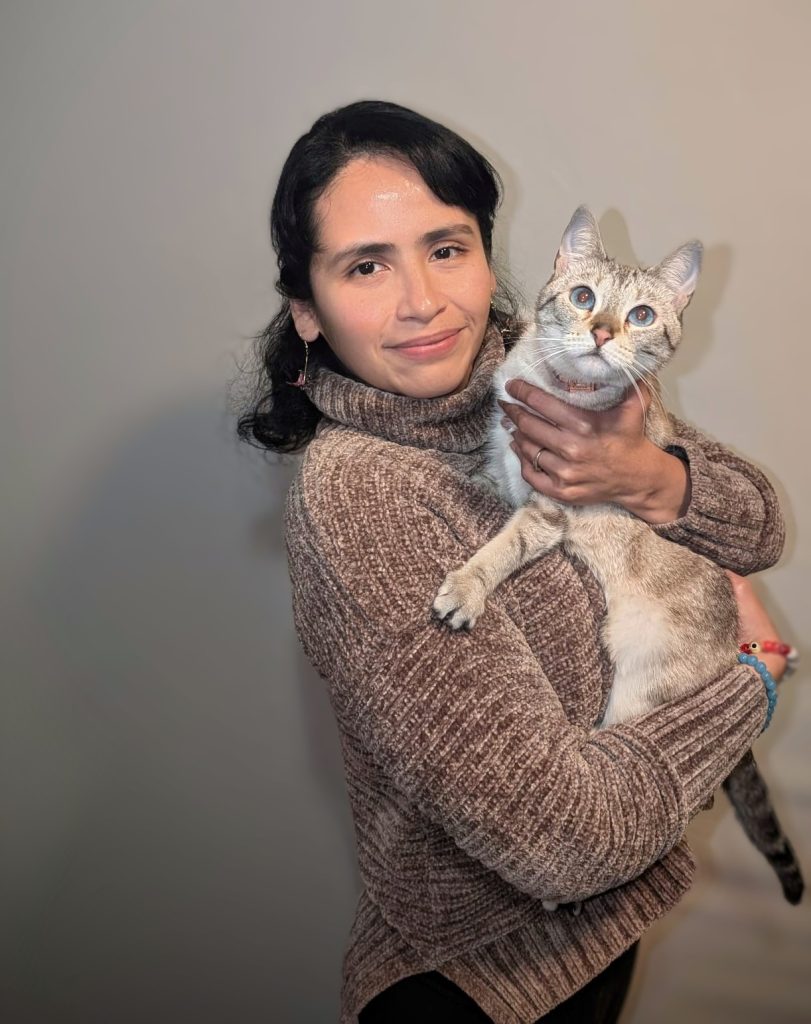
Currently, Yasmín Rojas co-directs and edits the literary and arts journal Isotopías. She is a translator and writer. She has published essays in Literal Latin American Voices, Latin American Literary Review, Criticismo, Caratula, and other journals.